
If you have spent time studying W. D. Gann, you have come across the phrase before. The Law of Vibration. And almost every time you encounter it, somebody explains it in a way that sounds like magic.
You will read that Gann tuned into the universe. You will read that he tapped into cosmic energy. You will read that vibration is about the frequency of your thoughts, intentions, or your alignment with the market.

Here is the strange part. Gann himself explained the Law of Vibration in public, in his own words, in 1909. That explanation still exists. Anyone can read it. And it sounds nothing like what people say about it today.
So let us go back and read what the man actually said.
The Interview that Started Everything
In December 1909, the magazine Ticker and Investment Digest published a long interview with a trader from Lufkin, Texas. He was thirty-one years old. His name was William Delbert Gann.
The man behind the magazine was Richard D. Wyckoff, a famous name in market history in his own right. And Wyckoff had not gone looking for a mystic. He had noticed something much plainer than that.
Gann kept sending the magazine’s exact prices in advance, not vague opinions about direction but specific numbers. When New York Central was trading at 131, Gann told them it would reach 145 before falling to 129. He did this often and accurately enough that the magazine decided to investigate him properly.
This is how the interview was set up, not as a promotion, but as an investigation.
What Gann Actually Said
Gann’s own account begins in a place most people would not expect. It begins with losing.
He said that in his early years, he lost thousands of dollars and went through the usual ups and downs of a beginner who enters the market without any real preparation. He then noticed that successful men in every other profession, lawyers, doctors and scientists, all spent years studying before they earned anything from their work. So he decided to do the same.
What he studied was recurrence. He began to notice that rises and falls in stocks and commodities kept returning at regular periods. That observation led him to one conclusion, and it is the foundation of everything that came afterwards. He decided that natural law was behind market movement.
So he gave himself ten years to study it.
And this is where the famous line arrives. After what he called exhaustive research into the known sciences, he found that the law of vibration let him determine the exact points at which stocks or commodities should rise and fall within a given time.
The Explanation People Leave Out
Then Wyckoff asked him to explain vibration in a way an ordinary reader could follow. Gann’s answer is the single most revealing thing in the whole interview, and it is also the part that gets quietly dropped whenever people retell this story.
He did not reach for anything spiritual. He reached for the technology of his day.
Gann said the law of vibration is the same law that wireless telegraphy, the wireless telephone and the phonograph are built on, and that without it, those inventions would have been impossible.

Sit with that for a second. In 1909, radio was the newest thing in the world. It was the iPhone of its era. And Gann’s explanation of vibration was not “the universe speaks to me.” It was closer to “this is the same principle that makes the radio work.”
He stayed on that track for the rest of the interview, too. He compared stocks to electrons, atoms and molecules. He referred to the scientific rule that the properties of an element follow a regular pattern as its atomic weight rises. He quoted Faraday. He said stocks are centres of energy and are therefore controlled mathematically.
Every reference he chose points the same way. Physics, chemistry and mathematics, in the plainest language he had.
Nine Months in the Library
The way he did the work says the same thing again.
Gann told Wyckoff that he spent nine months working night and day at the Astor Library in New York and the British Museum in London, going through records of stock transactions dating back to 1820. He went through the operations of Jay Gould, Daniel Drew, Commodore Vanderbilt and every other major operator of the era. He examined every quotation of Union Pacific he could find.
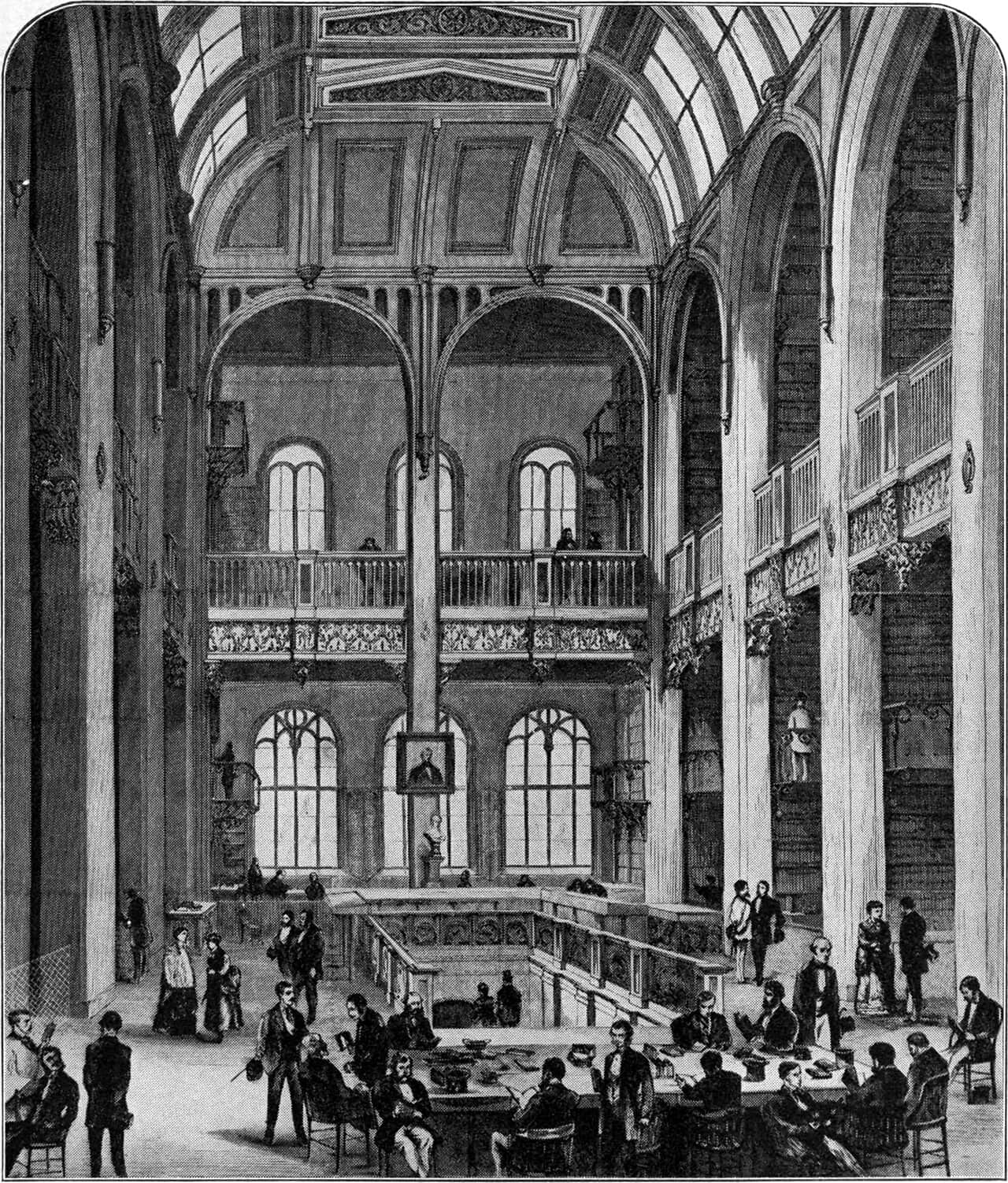
That is not a man in a trance. That is a man in a library, with a pencil, doing the least glamorous work imaginable for the better part of a year.
264 Wins Out of 286
Of course, none of this would matter if the results had not backed it up. And this is why the interview became famous rather than forgotten.
During October 1909, with a representative of the magazine watching him, Gann made 286 trades across twenty-five market days, both long and short. 264 of them made money. 22 lost. That is a little over 92%. The magazine also reported that his capital doubled ten times over that month.
The story people remember best is the wheat trade. Gann had said September wheat would touch $1.20 before the month ended. At noon Chicago time on 30 September, the last possible day, it was still below $1.08, and the call looked finished. Gann responded that if it did not reach $1.20 by the close, it would prove there was something wrong with his entire method. Wheat touched $1.20 in the last hour of trading and closed there.
One honest note here. This is a magazine account from 1909, not an audited statement, and you should hold it as exactly that. But Wyckoff was a serious man with a reputation to protect, and he put his own representative in the room. That is worth something.
The Silence Gann Left
There is one more line in the interview that matters more than all the numbers, and it is easy to miss.
The magazine recorded that Gann refused to disclose his method at any price.
So think about what he actually did. He told the world that the law existed. He told them where he had found it, which sciences he had drawn it from, and how many years it had taken. He gave them the results. And then he stopped.
He never told anyone how he applied it.
That gap is the reason for everything that followed. Every book, every forum argument, every mystical retelling of the Law of Vibration exists because Gann left a hole and other people filled it with whatever they had. Over a century, the science quietly drained out of the story, and the magic seeped in.
Three Things Worth Keeping
Go to the source before you go to the summary. Almost everything written about the Law of Vibration is a copy of a copy of a copy. The original is short, it is in plain English, and it is available to you. Read it first, then read what others say about it. You will be surprised how much of it does not match.
Vibration was a claim about measurement, not about mood. Gann was not describing a feeling or a state of mind. He was describing something he believed could be counted, and he said so using the vocabulary of physics. Any explanation that turns it into a mindset has quietly changed the subject.
The gap Gann left is the actual work. He proved the law existed and then refused to explain how he used it. That means nobody gets handed this. It has to be rebuilt, patiently, from the sources and from the charts.
What It All Comes Down To
The Law of Vibration has a reputation problem, and Gann did not create it. He described something measurable, in the language of the science of his day, and backed it with a record that a serious magazine put its own name behind. Everything mystical that surrounds the idea today was added later, by other people, to fill a silence he left on purpose.
That silence is still there. It is exactly what makes Gann’s work hard, and it is exactly what makes it worth doing.
If you want to study Gann the way he actually worked, from the sources and the numbers rather than the myths, our Gann courses are built on that approach. Have a look at the learning path and see where you fit.


