

Most traders have heard of WD Gann’s famous 1909 wheat forecast.
But very few understand what actually made it possible.
The story is often told as a legend. A bold forecast. A lucky strike.
It was neither.
It was a precise example of how Gann predicted market turns using time and price alignment.
Let’s look at what really happened.
The Famous 1909 Wheat Prediction
In September 1909, Wheat had never traded at $1.20 per bushel.
Daily movement was small. Roughly one cent per day.
Yet Gann publicly stated that Wheat would reach $1.20 by the end of September.
On the final trading day, Wheat was trading near $1.07. It seemed impossible.
Then, in the final hour, the Wheat surged and touched exactly $1.20.
The price. The timing. Both aligned.
That is what made this trade extraordinary.

Why This Trade Was So Unusual
Traders predict direction all the time. Some guess tops. Some guess bottoms.
But predicting:
The exact price
The exact date (time limit)
In advance
When the market had never traded there before
That is different.
This was not a lucky breakout. It was a forecast based on a framework, and that framework was built on Gann time and price principles.
The Real Lesson — Gann Time and Price Alignment
Most people focus only on the $1.20 level.
They miss the more important detail: the date (time limit).
Gann did not just project price. He projected when the price would meet a specific level. That is the foundation of Gann time and price.
Price moves in swings.
Time moves in cycles.
When both are complete together, markets accelerate.
If the price reaches a calculated level but the time is not complete, the move often fails.
If time completes but the price has not reached its level, the move can stall.
But when time and price align, moves become sharp and decisive.
The 1909 wheat trade was a clear example of this alignment.
This systematic relationship between time and price levels forms the foundation of our deeper research into hidden market timing principles inspired by Gann.
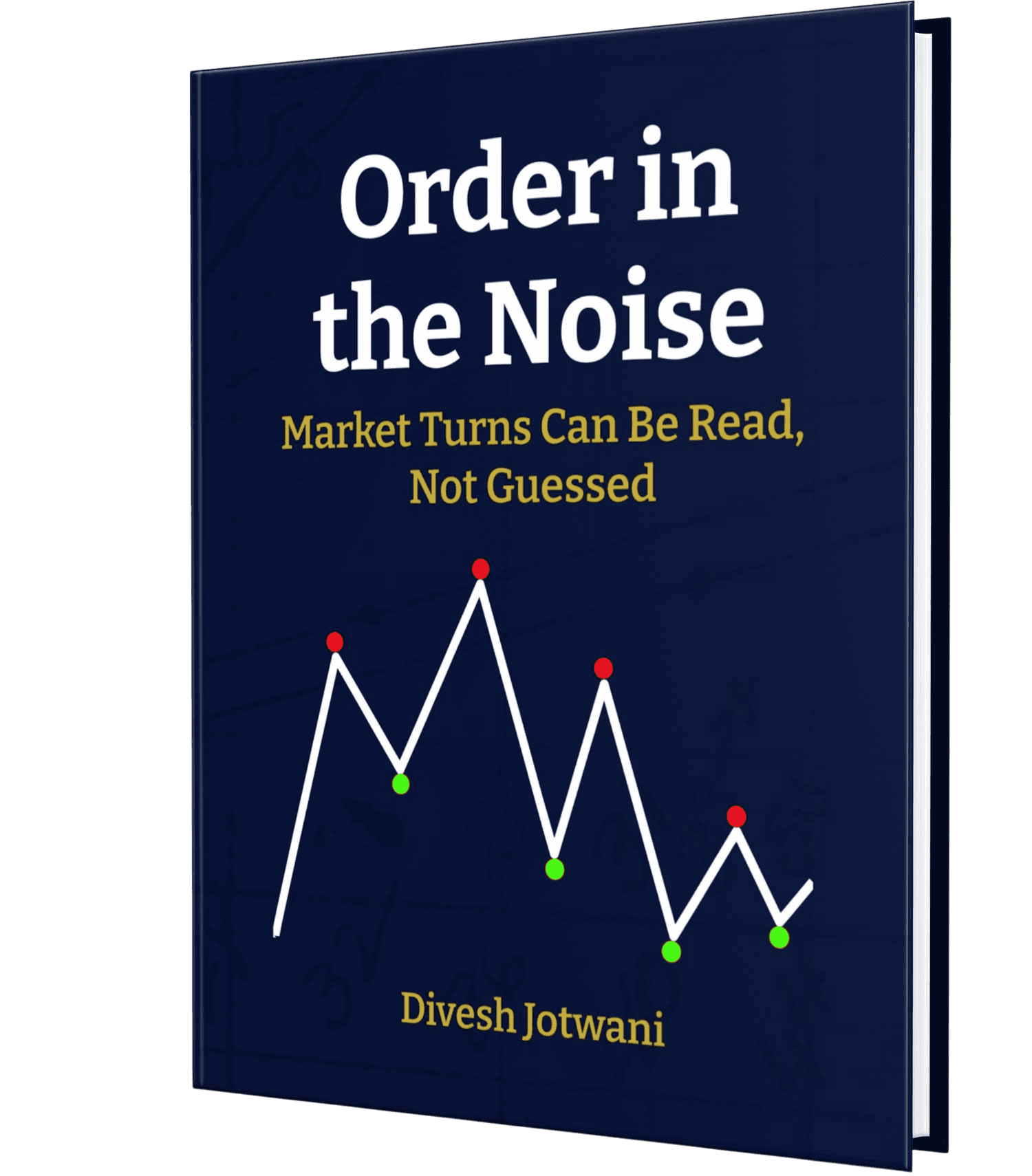
The Gann Trade Secrets Newsletter breaks down WD Gann’s trading methods and strategies. Inside, you’ll see how those strategies perform in real-world market conditions.
Subscribe and get a free copy of the report, Order in the Noise: Market Turns Can Be Read, Not Guessed.
Subscribe—Get The ReportGann Forecasting Method: What Most Traders Miss
Many traders reduce Gann to angles and chart drawings. That is a surface-level perspective.
Geometry has its place, but it only works when it is measured properly and in a structured way.
The deeper Gann forecasting methods are built on:
Measuring historical swings
Studying recurring time cycles
Calculating price intervals
Observing how markets behave when time and price meet
These price intervals often follow specific numerical relationships that repeat across markets.
This is how Gann predicted market turns.
Not by guessing or reacting.
But by preparing for a point where the structure suggested an imbalance would end.
The wheat trade was not magic. It was a mathematical preparation.
How Gann Predicted Market Turns With Precision
When traders ask how Gann predicted market turns, they often expect a secret formula.
Understanding where the market may turn is only one part of trading. Traders must also manage their positions carefully, because even strong forecasts can fail without proper risk management in trading.
The reality is simpler, but harder to execute.
He studied:
Prior market ranges
Repeating time intervals
Price expansions from key lows
Historical rhythm
Then he projected them forward in time using a proper framework.
If a calculated time window and a calculated price level pointed to the same area, that zone became important.
One practical way this connection becomes visual is through systematic time squaring techniques, in which specific time intervals reach their conclusion and signal potential turning points.
In 1909, that zone was $1.20 by the end of September.
The market did the rest.
Why This Still Matters in Modern Markets
Markets today move faster. We have intraday charts, derivatives, and algorithmic trading.
But the structures have not vanished.
Time still governs rhythm.
Price still expands in measurable intervals.
Understanding Gann time and price is not about copying history.
It is about learning how markets complete cycles. That’s crucial for understanding Gann’s original work.
Whether you trade stocks, futures, currencies, or intraday charts, the principle remains the same:
When time and price align, markets move with force.
That is the deeper lesson behind the 1909 wheat trade.
And that is why serious traders still study the Gann forecasting method today.
FAQs About WD Gann and the 1909 Wheat Trade of Gann
How did WD Gann predict the 1909 wheat price?
Gann accurately forecasted the price of Wheat using a combination of historical price data, market patterns, and mathematical formulas. His detailed study of past trends and unique techniques made such precise predictions possible.
What techniques did Gann use for market forecasting?
Gann’s forecasting techniques involved analyzing historical market data, identifying recurring cycles, and applying unique mathematical calculations. He also utilized insights from geometry and ancient writings to inform his predictions.
How did WD Gann predict the exact price of Wheat in 1909?
Gann combined historical market data, mathematical calculations, and his unique forecasting techniques to predict Wheat’s price of $1.20 per bushel on September 30, 1909. His methods often involved studying market cycles and patterns.
What made the 1909 wheat trade so significant?
The 1909 wheat trade showcased Gann’s extraordinary ability to make accurate market predictions and forecasts, solidifying his reputation as a master forecaster. Predicting such a precise price movement was unusual at the time.
What is Gann’s book, Tunnel Through the Air, about?
Gann’s book, Tunnel Through the Air, is believed to contain hidden insights into his trading and forecasting methods. Written with symbolic language and codes, it offers clues about how he approached market predictions.
Can Gann’s forecasting methods be applied today?
Yes, Gann’s principles of studying historical data, market cycles, and patterns remain relevant. Modern traders continue to study his methods for insights into forecasting.
Will there be a course on Gann’s methods?
We are developing a detailed WD Gann course that will explain and teach you the practical strategies and formulas he built into his trading system to make time and price forecasts.
Conclusion
The 1909 Wheat trade of Gann highlights the power of careful and accurate forecasting.
Gann achieved results that traders still respect today by analyzing historical market data, using mathematical formulas, and understanding market behaviour. His methods are a great resource for those looking to learn more about forecasting and market trends.
Whether you’re an experienced trader or just starting, the 1909 Wheat trade of Gann offers timeless inspiration for mastering market trends and making informed predictions.
If Gann’s work inspires you, stay tuned for more insights into his unique techniques and how they can be applied to today’s markets.

P.S: Our forthcoming course (Gann Time Squaring Technique) contains one of the most valuable Secrets of Gann for finding future turning points in time. If you’d like to learn more about it, you can click here.


