
Most traders meet Gann angles the wrong way.
They hear that Gann used angles to find turning points. So they buy costly software, spend months drawing lines on charts, and wait for the magic.
It rarely comes.
After all that money and time, most of them quit. They decide Gann angles do not work and move on.
Here is the truth. The angles are not the problem. The way people are taught to use them is the problem.
In this article, you will learn a simple way to use Gann angles as a calculation, not a drawing. No software. No protractor. No expensive tools. Just a basic sum that gives you possible support and resistance levels on any chart.
What a Gann Angle Actually Is
A Gann angle is a tool Gann used to study the strength of a trend and to mark possible support and resistance.
To draw these angles by hand, Gann used a plastic overlay, much like the protractor you used in school. The overlay had many angles on it. Out of all of them, the 1×1 angle, which sits at 45 degrees, was the one he treated as most important.

Gann once said that a trader could do well by working with the 45-degree angle alone, buying when the price held above it and selling when the price fell below it.
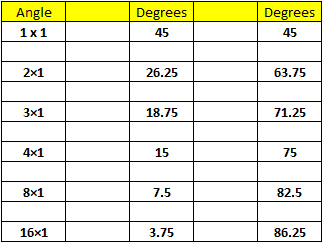
Apart from the 1×1, the other angles he watched were the 2×1, 3×1, 4×1, 8×1, and 16×1.
So far this is the version everyone teaches. Here is where it usually goes wrong.
Why Drawing the Angles Often Fails Today
People assume Gann only used angles by drawing lines on a chart. That is where most of them get stuck.
Gann drew his angles on charts he made by hand. They were proper square charts, built to an exact scale. Today we do not have that. Most charting software cannot build a true square chart, and keeping one updated by hand every day is close to impossible for a working trader.
So when you draw a 45 degree line on a normal software chart, it is not the same line Gann drew. The scale is off, and the result is off with it. That is why so many traders feel the angles let them down. They were never using them on the right kind of chart in the first place.
There is a better way, and it is one Gann himself used.

The Gann Trade Secrets Newsletter breaks down WD Gann’s trading methods and strategies.
Inside, you’ll see how those strategies perform in real-world market conditions.
Subscribe and get a free copy of the report, Order in the Noise: Market Turns Can Be Read, Not Guessed.
Subscribe—Get The ReportUse the Angle as a Number, Not a Line
This is the part most Gann students miss.
Gann did not only draw his angles. He also treated the degree of each angle as a number, and he added or subtracted that number from an important high or low to project price levels.
That sounds advanced. It is not. The calculation is simple enough for a school child to do.
You take the angle value, and you add it to a major bottom or subtract it from a major top, depending on the trend. The result is a price level that may act as support or resistance.
No drawing. No software. No true square chart needed. Just the high or low, and a number.
You will likely find these levels work as well as drawn angles, often better, because there is no scale to get wrong.
Real Examples on Real Charts
Here are a few examples of Indian and commodity markets so you can see the method at work. These are probabilities, not promises. The point is to show how close the levels can land.
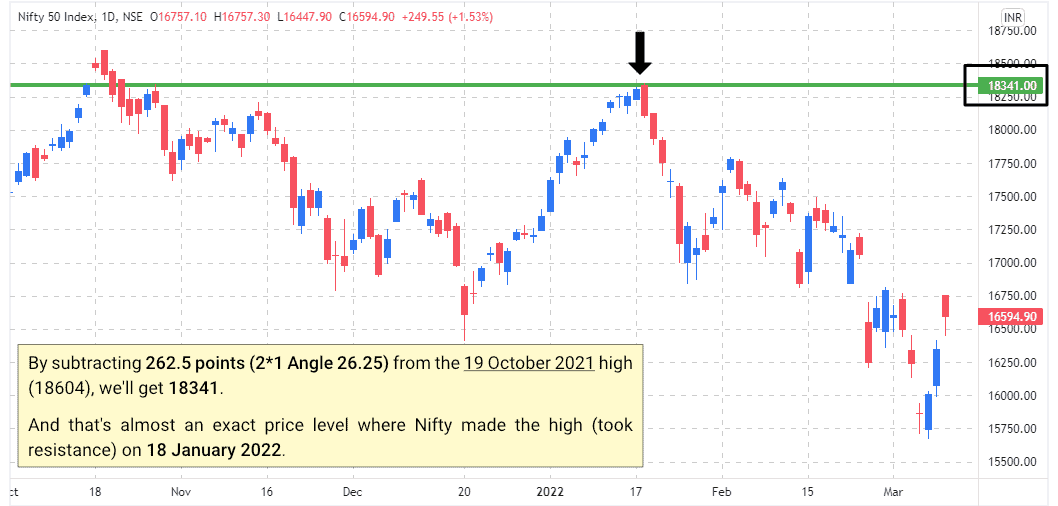
Nifty. From the 19 October 2021 high of 18604, subtract 262.5 points (the 2×1 angle value). That gives 18341. Nifty took resistance near that level on 18 January 2022 and then fell by around 14%.
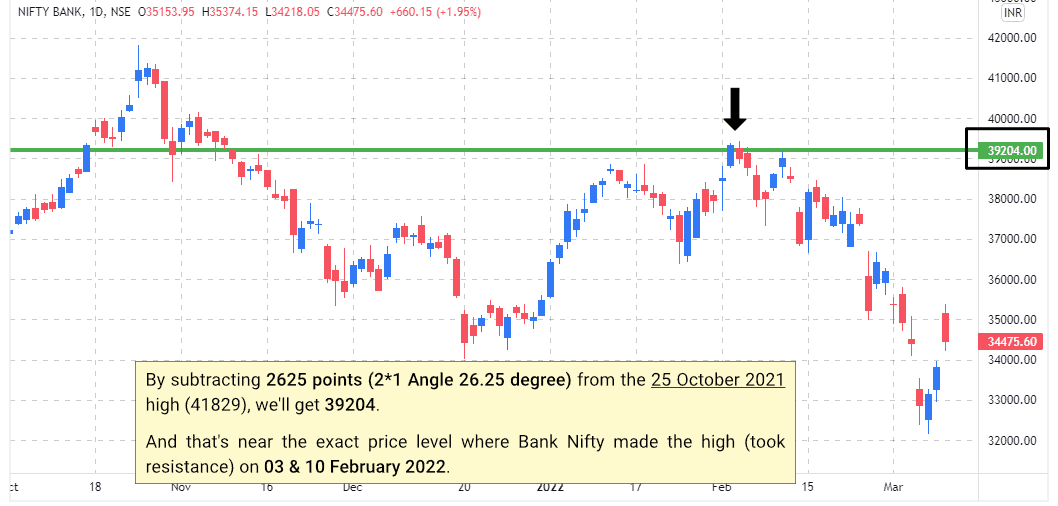
Bank Nifty. From the 25 October 2021 high of 41829, subtract 2625 points (the 2×1 angle value). That gives 39204. Bank Nifty took resistance near there on 3 and 10 February and fell by around 18%.
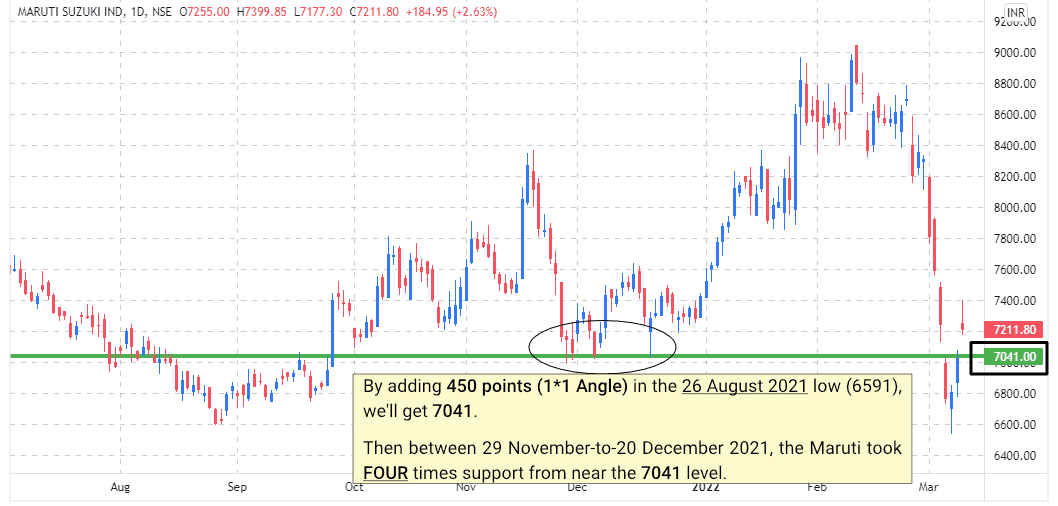
Maruti. From the 26 August 2021 low of 6591, add 450 points (the 1×1 angle value). That gives 7041. Between 29 November and 20 December 2021, Maruti found support near 7041 many times and then rose by around 26%.
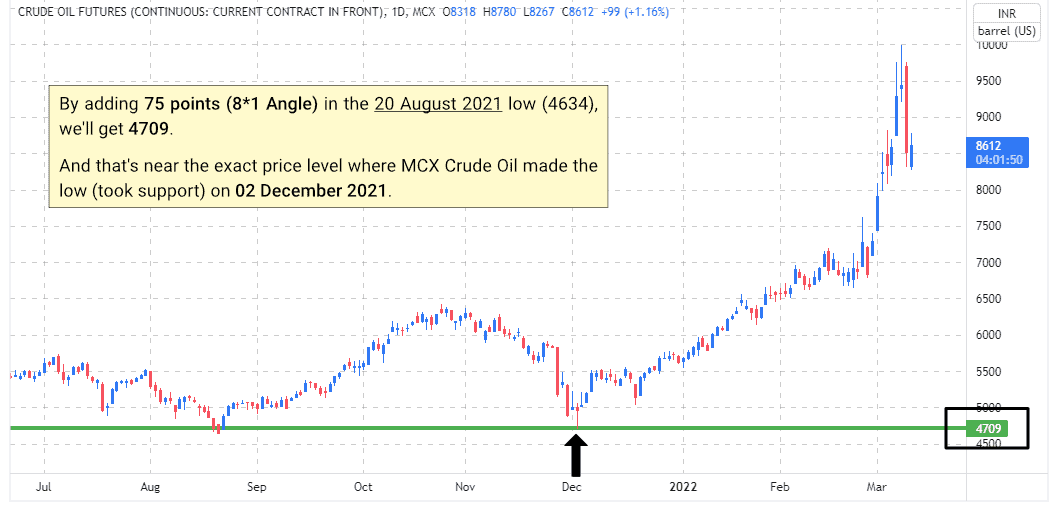
MCX Crude Oil. From the 20 August 2021 low of 4634, add 75 points (the 8×1 angle value). That gives 4709. Crude found support near there on 2 December 2021 and then surged by over 100%.
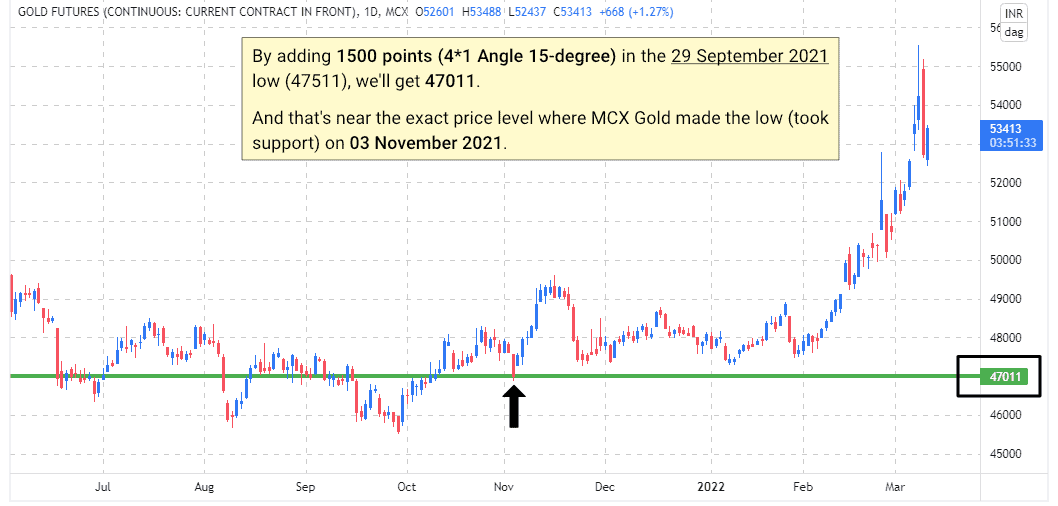
MCX Gold. From the 29 September 2021 low of 47511, work the 4×1 angle, and you reach the 47011 area. Between November 2021 and January 2022, Gold found support near 47011 several times and rose by around 15%.
These are not guarantees. Markets do not repeat on demand. But the method gives you a clear, calculated level to watch, instead of a line you hoped you drew correctly.
How This Connects to Support and Resistance
If you have ever searched for how to calculate Nifty or Bank Nifty support and resistance, this is one honest way to do it.
Most traders rely on pivot points or moving averages for their levels. Those are fine. But the Gann angle calculation gives you a different set of levels, drawn from the market’s own important highs and lows, using a number Gann trusted for decades.
You are not guessing where support might sit. You are projecting it from a real turning point with a fixed value. That is a calmer, more structured way to mark a chart.
What to Do Today
Stop spending money on software bought only to draw one Gann angle. For this method, you do not need it.
Take a recent major high or low on the chart you trade. Apply the angle value as a number. Mark the level. Then watch how the price behaves around it over the coming sessions.
Do that a few times and you will start to trust the method, because you built the level yourself with a simple sum.
The Next Step After Angles Is Time
What you just learned is one piece. It works on its own, but it sits inside a much bigger system of price, time and structure.
The version of Gann shared everywhere online stops at the surface. My courses go into the actual calculations and the market structure he used, so you can find turning points and project levels with real confidence instead of guesswork.
Two places to start, depending on what you need:
Timing Market Moves teaches you when a market is likely to turn, so you prepare your entry before the move begins. Take this one if your levels are fine, but your timing is off.
The Hidden Order teaches the rule-based mathematical method, where entry, exit and risk are all set before the trade starts. Take this one if you keep giving back profits.
You can also see the full set of WD Gann courses here.
Not sure which one fits you? Email me directly at [email protected] and tell me what you have already tried and where you are getting stuck. I read every message, and I reply personally. If neither course is right for you yet, I will tell you that too. – Divesh.


